
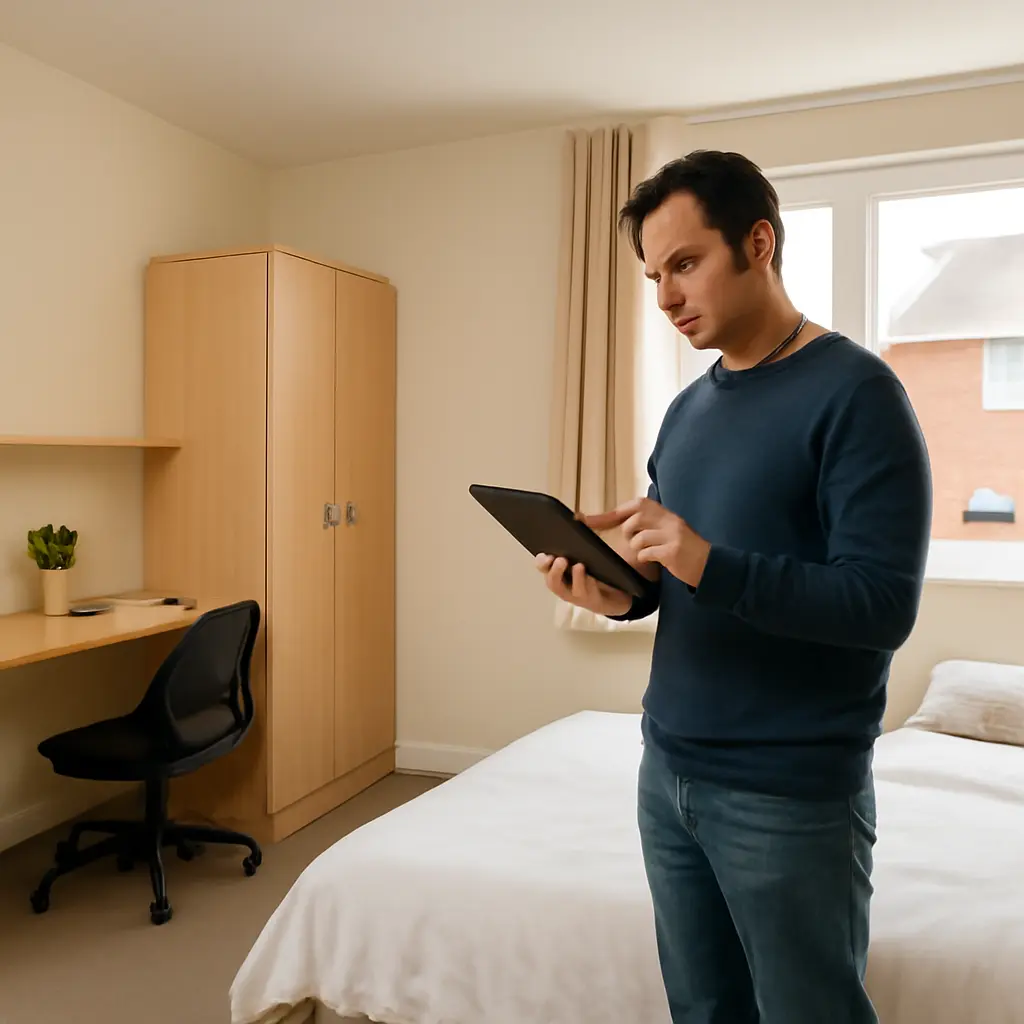
International students can find furnished rooms in unfamiliar cities by combining university housing services, reputable rental platforms, verified local contacts, and careful checks before sending money. A furnished room generally includes basic move-in furniture, but the term is not standardized, so students should confirm exactly what is provided, what the rent covers, and whether the listing and landlord are genuine. These steps matter because international arrivals often need housing before they can inspect it in person: UNESCO estimates that more than 6 million students studied outside their country of origin in 2022. A practical search therefore links four tasks—finding suitable listings, validating them remotely, understanding the agreement and costs, and arranging a safe arrival.
Finding furnished rooms: what the student housing search means
For this guide, a student housing search is the process of identifying, comparing, and securing a place to live that fits a student’s location, budget, timing, and furnishing needs. Housing authorities do not use one universal definition of “furnished”; in practice, it usually means that at least essential furniture is supplied, while kitchenware, bedding, internet service, and utilities may or may not be included. Students should treat each listing as a set of claims to verify, rather than assume the label guarantees a ready-to-live-in room.
The main options are university-managed residences, private student residences, rooms in shared homes, and short-term furnished rentals. They differ in price, contract length, privacy, and support. University housing can offer an easier first step for someone arriving from abroad, while a shared home may provide more flexibility or a lower-cost room. Prices vary substantially by city and season, so a student should compare current local listings and the university’s cost-of-living guidance rather than rely on a global average.
University residences and housing offices
A university residence is accommodation operated or approved by a university, often with furnished rooms, shared facilities, and defined application procedures. The institution’s international office or housing team can explain application dates, eligibility, deposits, contract terms, and whether a room includes bedding or kitchen equipment. This route is particularly useful when a student needs a credible starting point, but availability may be limited and application deadlines can precede the academic term by months.
Private student residences and shared homes
Private student residences are purpose-built or managed buildings marketed to students; shared homes are privately rented properties where occupants share facilities such as a kitchen or bathroom. Both may advertise furnished rooms, but students should confirm room dimensions, storage, household rules, guest policies, and whether the named landlord or operator is responsible for repairs. In shared housing, a written inventory and clear agreement about cleaning, bills, and common areas can prevent disputes after move-in.
Verifying a furnished-room listing before paying
Listing verification means checking that the property exists, the person offering it has authority to rent it, the stated features are accurate, and the payment process is legitimate. The U.S. Federal Trade Commission advises renters to be cautious if a supposed landlord demands payment before a viewing or pressures them to use wire transfers, gift cards, or cryptocurrency. These warnings are relevant internationally: payment methods and tenant protections differ by country, but urgency, unusually low prices, and refusal to provide verifiable details are common reasons to pause.
Confirm the room and the person offering it
Ask for a live video tour that shows the building entrance, the specific room, windows, storage, shared facilities, and the route between them. Request the property address and the landlord’s or agent’s full name, then check those details through the university, a recognized housing provider, or the relevant local property registry where available. A video tour is useful evidence, but it does not prove ownership or authority to rent; students should independently verify the person’s role and avoid relying only on documents or links supplied by the seller.
Check the furniture, services, and total cost
A furnished-room checklist turns a broad marketing claim into specific, testable details. Ask whether the room includes a bed and mattress, desk, chair, wardrobe, lighting, and curtains; whether shared spaces have a cooker, refrigerator, and laundry facilities; and whether internet, heating, electricity, water, and local taxes are included. The advertised rent is not necessarily the full monthly cost. Compare the rent plus deposits, agency or administration charges, utility estimates, transport, and any required insurance, using local tenant-advice guidance to understand which charges are lawful.
Recognize common rental-scam warning signs
A rental scam is a deceptive offer intended to obtain money or personal information without providing a legitimate tenancy. Warning signs include a landlord who claims to be overseas and cannot arrange a viewing, copied photographs, inconsistent names or addresses, pressure to pay immediately, and requests to send money through an untraceable or unusual method. The FTC recommends searching the property address and the owner or company name to see whether the same listing appears elsewhere at a different price or with conflicting contact details. If a payment is demanded before the student can verify the property and agreement, stop and consult the university housing office or a local tenants’ organization.
Comparing contracts, location, and move-in readiness
After a listing passes basic checks, the next task is to compare the tenancy terms with the student’s study dates and arrival plans. A furnished room can still be unsuitable if the lease begins too late, ends before exams, or imposes costs the student did not budget for. Contract rules vary by jurisdiction, so students should seek local advice before signing and keep a copy of every agreed term, inventory, and payment record.
Read the agreement and document the inventory
A rental agreement sets out the parties, address, tenancy dates, rent, deposit, payment schedule, included services, and responsibilities for repairs and damage. Confirm whether the contract names the actual room, whether subletting is permitted, and what notice is required to leave. At move-in, photograph the room and furniture, record existing damage, and compare the condition with a signed inventory. In England, for example, government guidance states that most private tenants must have their tenancy deposit protected in a government-approved scheme; students should check the equivalent rules where they will live.
Assess commute, safety, and daily access
A convenient room is one that works for ordinary routines, not simply one that looks close on a map. Check the actual journey to campus at likely class times, public transport frequency, late-night routes, nearby groceries, and access to health services. Ask the university about local safety resources and student transport discounts. If the student cannot visit beforehand, use a map and live video call to understand the surrounding street, building access, lighting, and any practical limitations such as stairs or shared entrances.
Arrange a reliable first-night plan
Move-in readiness means the student can enter the property, sleep comfortably, and meet immediate needs on arrival. Confirm the key handover time, the contact person, the exact entrance, and what to do if travel is delayed. Ask whether bedding, towels, cookware, and cleaning supplies are provided; if not, identify nearby shops or arrange a short initial stay through a verified provider. Keep the signed agreement, landlord contact, address, and emergency numbers accessible offline, and avoid arriving without a confirmed way to enter the accommodation.
A practical search sequence for international students
A staged search reduces the chance of making a rushed decision across time zones. Begin with official sources, then widen the search while applying the same verification steps to every offer. A simple comparison table can track rent, deposit, included furniture, utilities, commute, contract dates, and verification status; this makes trade-offs visible instead of letting a low advertised price dominate the decision.
- Contact the university housing office and ask about residence availability, approved providers, local rental rules, and arrival support.
- Set a realistic total monthly budget and identify the acceptable commute, move-in date, and minimum furniture requirements.
- Compare university housing, reputable student-accommodation operators, and established rental platforms; treat social-media posts and informal referrals as leads that require extra checks.
- Request a live viewing, verify the address and the person’s authority, and get every promised item and included cost in writing.
- Review the contract and deposit rules for the destination country before transferring money; keep receipts and signed documents.
- Confirm keys, arrival timing, utilities, and first-night essentials, then record the room’s condition when taking possession.
A useful visual aid is a comparison chart with one row per room and columns for total monthly cost, furnishing checklist, commute time, contract length, and verification status. A second simple chart can map the student’s arrival timeline—from offer acceptance to key collection—to reveal gaps such as a lease that starts after the flight or a residence office that closes before arrival.
Conclusion: secure the room, not just the listing
International students can land furnished rooms more confidently by starting with university support, comparing the main housing types, verifying the property and provider, and checking the true cost and contract before paying. “Furnished” should be confirmed item by item, while location, deposit rules, utilities, and move-in arrangements deserve equal attention. With international student mobility exceeding 6 million in UNESCO’s 2022 estimate, reliable arrival housing is an important part of making study abroad workable. Students should consult their university’s housing office and the destination’s official tenant guidance before committing, and should pause whenever a landlord’s identity, property access, or payment request cannot be independently verified.
Sources: UNESCO Institute for Statistics, Global Flow of Tertiary-Level Students, https://uis.unesco.org/en/uis-student-flow; Federal Trade Commission, Avoiding Rental Scams, https://consumer.ftc.gov/articles/what-know-about-rental-listing-scams; U.S. Department of State, Study Abroad: Housing, https://studyabroad.state.gov/; GOV.UK, Tenancy Deposit Protection, https://www.gov.uk/tenancy-deposit-protection.