
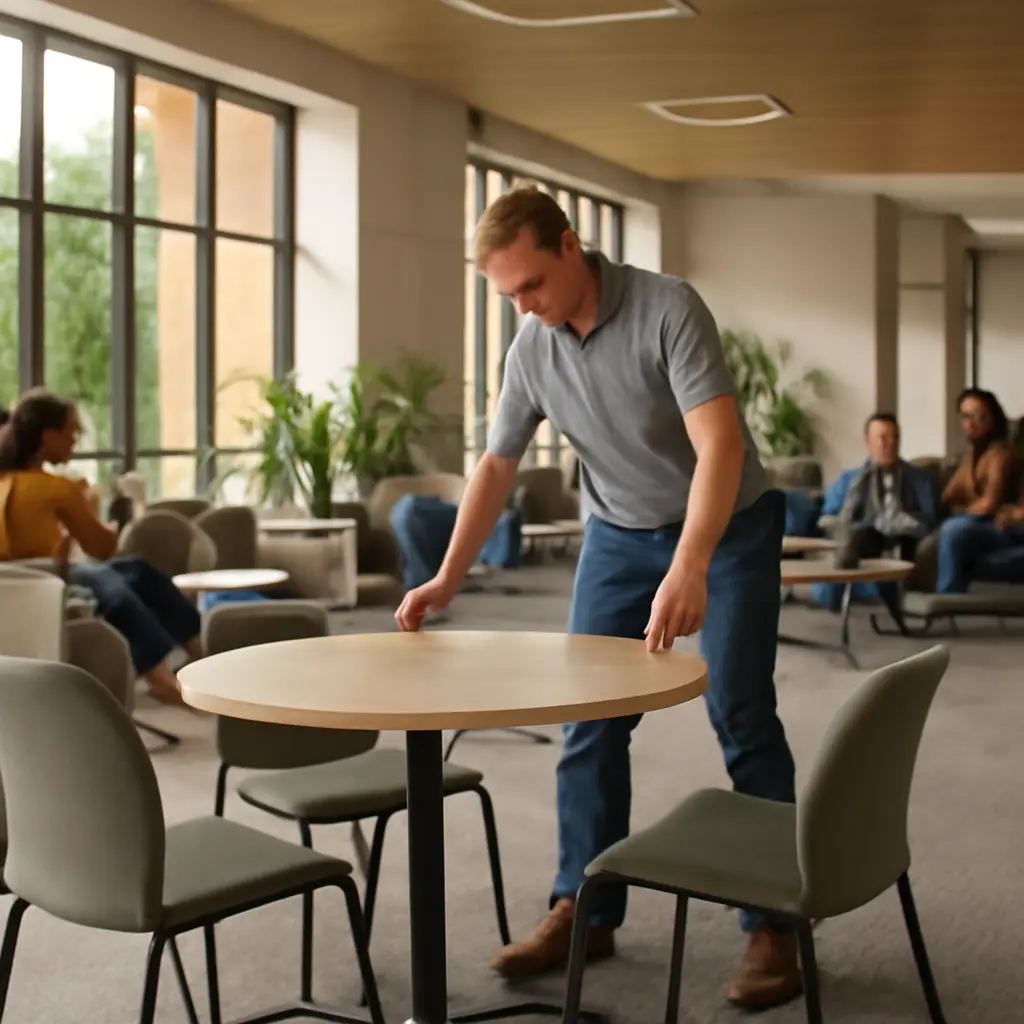
Shared campus spaces are the informal places where students meet, study, eat, and build relationships beyond the classroom. Their design and everyday use can shape whether students feel connected to one another and to campus life: a 2023 Student Voice survey by Inside Higher Ed and College Pulse found that 58% of students said they felt lonely at least once a week. Research on belonging and campus environments points to a practical response: create welcoming, accessible places that make repeated, low-pressure interaction possible. The sections below explain how shared spaces foster connection, which types of spaces matter, and what colleges can do to make them work for more students.
Shared campus spaces foster student connection
Shared campus spaces are places used by multiple members of a campus community, including student unions, libraries, dining areas, lounges, courtyards, residence-hall common rooms, and outdoor paths. Their social value comes not simply from bringing people into the same room, but from making it comfortable and possible for them to interact—whether through conversation, shared activities, or familiar repeated encounters.
The National Academies of Sciences, Engineering, and Medicine describes social connection as involving the structure, function, and quality of relationships. On campus, shared spaces can support all three: they bring people into contact, provide settings for mutual support and activities, and help students develop relationships that feel meaningful. This matters for student experience because loneliness and belonging are widespread concerns. The 2023 Inside Higher Ed and College Pulse survey reported that 58% of students felt lonely at least once a week, while the U.S. Surgeon General’s 2023 advisory on social connection identifies social relationships as important to health and well-being.
Informal encounters and repeated contact
Informal encounters are unplanned or low-pressure interactions, such as greeting a classmate in a café or joining a group at a common table. Repeated encounters can turn recognition into conversation and, over time, familiarity. A well-used lounge or campus café therefore contributes something different from a scheduled lecture: it gives students opportunities to connect without requiring a formal introduction or commitment.
These interactions are not guaranteed by proximity alone. A room can be busy yet feel socially closed if seating is isolated, noise makes conversation difficult, or students cannot find a place to sit. The design and social norms of a space help determine whether being together becomes interaction.
Belonging, well-being, and participation
Belonging is the sense that a person is accepted, valued, and included in a community. Shared spaces can make campus feel more navigable and welcoming by giving students places to meet peers, take part in activities, and build routines. The U.S. Surgeon General’s advisory emphasizes that social connection is relevant to individual and community well-being; colleges can treat accessible gathering places as one part of a broader approach that also includes advising, student organizations, and mental-health support.
A space should not be treated as a substitute for those services or as a cure for loneliness. It is better understood as campus infrastructure that can make social participation easier, particularly when students have welcoming activities and clear ways to join them.
Campus space types create different opportunities for connection
Different kinds of shared campus spaces support different forms of contact. A dining hall may encourage casual conversation, a student union may host clubs and events, and a library can provide quiet co-presence. These are related but distinct functions: effective campus planning offers a variety of settings rather than expecting one room to meet every social, academic, and accessibility need.
Student unions and activity hubs
A student union is a campus hub that commonly combines social seating, student services, food, and spaces for clubs or events. Its mix of uses can attract students for different reasons and create opportunities for them to encounter one another. Flexible rooms, visible event information, and seating suitable for both individuals and groups can help a union serve students who want a lively gathering as well as those who need a quieter place to pause.
For example, a club fair in a central union can connect new students to organizations, while everyday seating gives them a place to return after the event. The event creates a first point of contact; repeated visits can help sustain it.
Libraries and learning commons
Libraries and learning commons support both academic work and social contact. Group-study rooms, shared tables, tutoring areas, and informal seating allow students to work alongside peers and ask for help. Quiet zones remain essential, so a well-planned library distinguishes collaborative areas from spaces intended for focused individual study.
This balance broadens access to connection: students can begin by studying near others without needing to participate in a large event. Campus planners can assess whether hours, room-booking rules, furniture, and noise controls support both independent work and collaboration.
Dining areas, lounges, and residence-hall common rooms
Dining areas and lounges are everyday social settings where shared meals, short breaks, and casual conversation can build familiarity. Residence-hall common rooms can provide a nearby setting for residents to meet, study, or take part in floor activities. Their usefulness depends on practical details: whether students can afford or access the space, whether it is open at convenient times, and whether the arrangement welcomes people who arrive alone as well as groups.
A residence-hall lounge, for instance, may become more inviting when it includes movable seating, a clearly communicated schedule of optional activities, and quiet as well as conversational areas. These features make participation easier without requiring every student to socialize in the same way.
Outdoor spaces and circulation routes
Courtyards, gardens, plazas, and pedestrian routes can support brief encounters and informal gatherings between classes. Outdoor settings may provide room for events, rest, and conversation, while accessible paths connect students to other campus destinations. Their social value depends on conditions such as weather protection, lighting, seating, safety, and step-free access.
Outdoor areas also illustrate why connection is shaped by a network of places, not just a single building. A comfortable route with places to stop can link a library, dining hall, and student center into a more usable social landscape.
Inclusive design makes shared spaces more welcoming
Inclusive campus space design considers whether people with different abilities, identities, schedules, budgets, and social preferences can use a place comfortably. A gathering space may be visually attractive yet fail to support connection if it is inaccessible, expensive to use, overwhelming for some students, or perceived as belonging only to a particular group. Inclusion is therefore both a design question and a question of how a space is managed.
Physical, sensory, and practical access
Accessible design includes step-free routes, usable entrances, appropriate seating, clear wayfinding, and facilities that accommodate people with disabilities. Sensory access also matters: lighting, noise levels, and the availability of quieter areas can affect whether students can remain in a space. Practical access includes opening hours, transportation links, cost, and access to food or basic amenities.
The U.S. Access Board’s accessibility standards provide requirements for accessible facilities, while universal-design principles encourage environments that work for a broad range of users. Colleges can use accessibility reviews and feedback from disabled students to identify barriers that a floor plan alone may not reveal.
Cultural welcome and a sense of ownership
Students are more likely to use a space when they can see that their presence and activities are welcome. Campus displays, student-led events, multilingual information, and policies that allow varied forms of gathering can help communicate that a space is shared. Consultation with cultural organizations and student groups is important because a design that seems neutral to planners may not feel equally welcoming to everyone.
A practical approach is to invite students to help shape how rooms are furnished, scheduled, and used. This can reveal needs that campus administrators might otherwise miss, such as prayer or reflection space, lactation facilities, gender-inclusive restrooms, or areas for commuter students between classes.
Choice between sociability and solitude
An inclusive social environment offers choice. Some students seek lively conversation, while others prefer quiet company, brief interactions, or a place to be alone without feeling excluded. A mix of open tables, small-group seating, quiet corners, and reservable rooms lets students participate at different levels.
This range also reduces the pressure to treat sociability as one fixed behavior. A student reading in a shared lounge or attending a low-key activity may be engaging with campus life even without joining a large group conversation.
Colleges can evaluate and improve social spaces
Campus spaces should be evaluated by how students use and experience them, not only by appearance or square footage. A useful assessment combines observation, student feedback, access reviews, and operational data. That helps institutions identify who uses a space, who does not, and what changes might make participation easier.
Measure use and experience together
Occupancy counts and foot traffic can show when a place is busy, but they do not prove that people feel welcome or form connections there. Colleges can pair counts with short surveys, focus groups, accessibility audits, and observation at different times of day. Useful questions include whether students can find a seat, feel comfortable arriving alone, understand how to join activities, and consider the space accessible.
The 2023 Inside Higher Ed and College Pulse finding that 58% of surveyed students felt lonely at least weekly offers a reason to take student experience seriously, but it should not be used as a direct measure of whether a particular building works. Institutions need local evidence to understand the relationship between their spaces and students’ day-to-day experiences.
Use low-cost pilots and student partnerships
Before undertaking major renovations, colleges can test changes such as rearranged furniture, longer opening hours, pop-up events, improved signage, or additional quiet seating. Student organizations and residence-life teams can help run activities that give students an easy reason to visit. Pilots allow campuses to learn which changes improve use and which create unintended barriers.
For example, a campus could trial a weekly shared meal in a commuter-friendly location, then ask participants and nonparticipants about timing, cost, access, and the atmosphere. The purpose is not to assume that one event will suit everyone, but to use feedback to refine programs and spaces.
Connect places to services and campus routines
A social space is more useful when it connects with the rhythms of student life. Locating peer mentoring, advising drop-ins, club information, or wellness activities near common gathering areas can make support easier to discover. Coordination with academic schedules, transit, dining hours, and residence-life programming can also help students fit participation into busy days.
These connections should preserve choice and privacy. Students should be able to use a lounge or library without being expected to disclose personal concerns or join a program. Shared spaces can make support visible while remaining welcoming for ordinary everyday use.
Conclusion: shared spaces are part of campus connection
Shared campus spaces shape student connection by enabling informal encounters, repeated contact, group activities, and a sense of belonging. Student unions, libraries, dining areas, residence-hall lounges, and outdoor routes each offer distinct opportunities, while inclusive design helps ensure those opportunities are accessible and welcoming. The evidence on student loneliness underscores the relevance of the issue, but individual campuses should assess their own spaces through student feedback and observed use rather than relying on a national statistic alone.
Colleges can start by asking students who uses existing gathering places, who feels left out, and what small changes would make participation easier. Further reading from the National Academies and the U.S. Surgeon General can help campus leaders connect space planning with broader evidence on social connection and well-being.
Sources: Inside Higher Ed and College Pulse, “Student Voice: Mental Health and Well-Being,” 2023, https://www.insidehighered.com/news/student-success/health-wellness/2023/10/10/college-students-report-loneliness-anxiety; National Academies of Sciences, Engineering, and Medicine, Social Isolation and Loneliness in Older Adults: Opportunities for the Health Care System, 2020, https://nap.nationalacademies.org/catalog/25663/social-isolation-and-loneliness-in-older-adults-opportunities-for-the; U.S. Surgeon General, Our Epidemic of Loneliness and Isolation: The U.S. Surgeon General’s Advisory on the Healing Effects of Social Connection and Community, 2023, https://www.hhs.gov/sites/default/files/surgeon-general-social-connection-advisory.pdf; U.S. Access Board, Americans with Disabilities Act (ADA) Accessibility Standards, https://www.access-board.gov/ada/.