
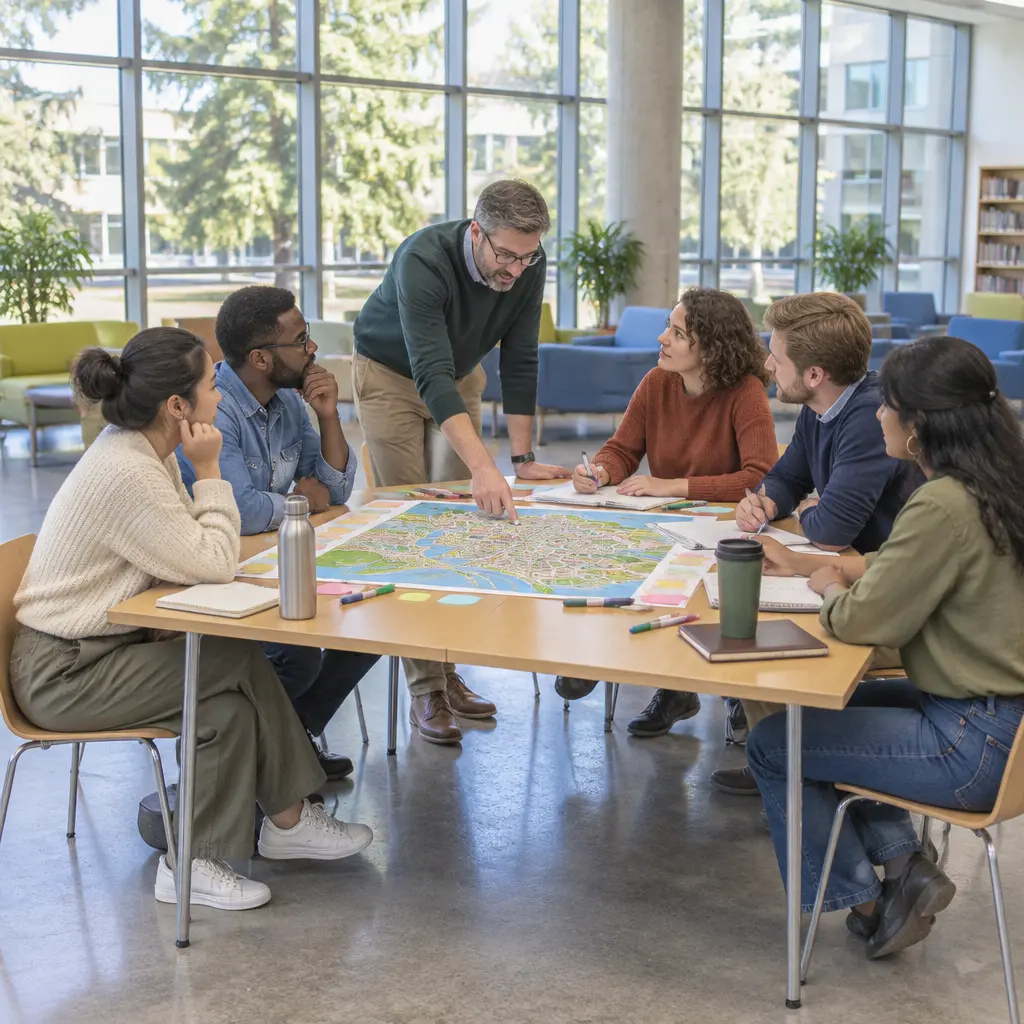
Cultural exchange facilitation is the intentional design of activities and conditions that help people from different cultural backgrounds learn with and from one another. Unlike relying on chance conversations in shared kitchens or hallways, structured interaction gives participants a clear purpose, equitable opportunities to contribute, and support for reflection. Research on intergroup contact suggests that well-designed encounters can reduce prejudice, especially when participants have equal status, shared goals, cooperation, and institutional support. This article explains those design principles, compares formats such as facilitated dialogue and collaborative projects, and offers practical steps for putting them into practice.
Facilitated Cultural Exchange: Definition and Design Principles
Cultural exchange facilitation is a planned process for creating meaningful interaction across cultural differences, rather than simply placing people in the same setting. The practice draws on Gordon Allport’s contact hypothesis, presented in The Nature of Prejudice (1954): intergroup contact is more likely to improve relations when it involves equal status, common goals, cooperation, and support from relevant authorities or institutions. These conditions are design principles, not a guarantee of positive outcomes; the quality, safety, and continuity of interaction matter.
The need is practical as well as social. The Institute of International Education reported that 1,126,690 international students studied at U.S. colleges and universities in the 2023–24 academic year. Enrollment alone does not ensure meaningful exchange: students may share classrooms and residences while still socializing mainly within familiar networks. Structured programming can help turn proximity into purposeful contact.
Equal status and shared purpose
Equal status means participants meet as contributors, rather than one group being treated as the host, expert, or representative and another as a guest or subject. A shared purpose—such as completing a community project, comparing local histories, or solving a case study—gives people a reason to cooperate. Facilitators can reinforce these conditions by distributing roles, materials, speaking time, and decision-making authority fairly.
Cooperation and institutional support
Cooperation requires participants to depend on one another’s contributions to reach a common outcome. Institutional support means that organizers, educators, or community leaders establish expectations, provide resources, and respond to exclusion or conflict. In the contact hypothesis, these conditions help distinguish constructive engagement from unstructured exposure, where stereotypes or status differences may go unchallenged.
These principles describe the conditions to aim for. The next question is how to translate them into particular formats, from dialogue sessions to sustained collaborative work.
Structured Interaction Formats: From Dialogue to Collaboration
Structured interaction formats are repeatable activities with defined goals, participation guidelines, and opportunities for reflection. Common types include facilitated dialogue, intercultural mentoring, cooperative projects, and guided cultural-sharing activities. They can be combined, but should be selected according to participants’ needs, available time, and the sensitivity of the subject matter.
Facilitated dialogue
Facilitated dialogue is a guided exchange in which participants listen, ask questions, and examine different perspectives without being required to reach agreement. A trained facilitator establishes norms—for example, speaking from personal experience, avoiding assumptions about entire groups, and allowing participants to pass on a question. Dialogue is particularly useful for exploring identity, belonging, language, or misunderstandings, but it should not pressure anyone to disclose personal experiences.
Cooperative projects and reciprocal learning
A cooperative project gives participants a shared task that requires different skills or perspectives. Teams might document neighborhood stories, design an inclusive campus event, or create a multilingual resource. Reciprocal learning is central: each participant contributes knowledge, and no one is assigned to speak for an entire culture. A concrete product can sustain engagement, while a debrief helps participants notice how decisions and roles were negotiated.
Peer mentoring and cultural-sharing activities
Peer mentoring pairs or small groups participants for repeated, practical exchanges, such as navigating campus services, practicing languages, or comparing approaches to study and work. Cultural-sharing activities—such as discussing music, food traditions, or celebrations—can provide approachable entry points. They work best when framed as personal stories rather than demonstrations of supposedly universal cultural traits, and when the activity includes conversation rather than stopping at performance or tasting.
A format becomes effective through its implementation. Clear preparation, skilled facilitation, and follow-up are what make an activity more than a one-time event.
Program Design: Preparation, Facilitation, and Evaluation
Program design is the process of matching an exchange activity to a defined purpose, participant context, and available support. A useful sequence is to identify the intended outcome, consult participants, choose an appropriate format, establish safeguards, and decide how learning will be assessed. The National Academies’ 2017 report The Integration of Immigrants into American Society emphasizes that integration is multidimensional and shaped by institutions and social contexts; exchange programs should therefore avoid treating a single event as a complete measure of inclusion.
Needs assessment and participant preparation
A needs assessment identifies who will participate, what barriers they face, and what they hope to gain. Organizers can ask about language access, scheduling, accessibility, prior experience, and topics participants consider sensitive. Preparation may include a short orientation, clear learning goals, definitions of key terms, and an explanation of how feedback or concerns will be handled. Consultation should happen before activities are finalized, not merely after decisions have been made.
Facilitator practice and psychological safety
Facilitators guide participation without controlling what participants must think or reveal. They can use structured turn-taking, small-group discussion, anonymous questions, and periodic check-ins to reduce domination by more confident speakers. Psychological safety does not mean avoiding disagreement; it means participants can ask questions, express uncertainty, or set boundaries without being demeaned. Facilitators should interrupt stereotyping and harassment, while distinguishing good-faith curiosity from demands that individuals educate others or defend a group.
Evaluation and evidence of progress
Evaluation measures whether a program met its stated goals and identifies improvements. Organizers can combine attendance and retention data with brief participant surveys, interviews, reflective writing, or observation of collaboration. Useful indicators include whether participants report new cross-group connections, feel able to contribute, understand perspectives more accurately, or intend to continue contact. Results should be interpreted cautiously: satisfaction with an event is not the same as durable attitude change, and self-reports may not capture unequal experiences across groups.
Real-World Applications and Common Design Risks
Cultural exchange facilitation applies in universities, workplaces, community organizations, and local public programs. In higher education, international enrollment creates opportunities for exchange, but institutions need to build programs that connect domestic and international students through shared work rather than assuming residence halls or international festivals will do so. In workplaces, cross-cultural project teams can establish common goals and explicit communication norms. In communities, oral-history or neighborhood-planning projects can bring residents together around local priorities.
The U.S. Department of Education’s National Center for Education Statistics reported that, in fall 2021, about 4.6 million students in U.S. degree-granting postsecondary institutions were taking at least one distance education course. This figure illustrates how interaction increasingly occurs across both physical and online settings. Virtual exchange can widen access across locations, but organizers should account for time zones, bandwidth, language, and unequal access to quiet spaces or devices.
From shared kitchens to purposeful encounters
Informal shared spaces can support connection, but their benefits are uneven: people may lack time, confidence, a common language, or a reason to begin a conversation. A structured meal, for example, can include rotating discussion prompts, mixed seating, and a collaborative activity while leaving room for informal conversation. The design should invite participation without making food, accent, or cultural identity a test of belonging.
Avoiding tokenism and one-off programming
Tokenism occurs when a participant is treated as a spokesperson or cultural exhibit rather than as an individual. One-off programming is not inherently harmful, but it rarely provides enough time to build trust or assess lasting outcomes. Organizers can reduce these risks by offering repeat sessions, sharing decision-making, compensating community expertise where appropriate, and creating routes for participants to shape future activities.
Managing disagreement and power differences
Disagreement can be productive when participants have clear norms and a facilitator can address unequal power. It becomes unsafe when people are targeted, pressured to disclose trauma, or expected to absorb repeated disrespect in the name of learning. Programs should provide confidential ways to raise concerns, explain limits to confidentiality, and establish procedures for pausing or ending an activity. Organizers should also review who sets the agenda and whose knowledge is treated as authoritative.
Conclusion: Make Cultural Exchange Intentional and Reciprocal
Facilitated cultural exchange turns proximity into purposeful interaction by applying the contact principles of equal status, shared goals, cooperation, and institutional support. Dialogue, collaborative projects, peer mentoring, and cultural-sharing activities each offer different ways to build connection. Thoughtful preparation, capable facilitation, attention to power and safety, and realistic evaluation help ensure that programs are reciprocal rather than tokenistic.
Institutions and community groups should begin by asking participants what meaningful exchange would look like, then design repeated opportunities around shared work and mutual learning. For further reading, consult Allport’s foundational work on intergroup contact, the National Academies’ research on immigrant integration, and the Institute of International Education’s enrollment reporting. The broader lesson is simple: belonging is not produced by proximity alone; it grows when people have structured, equitable opportunities to contribute and learn together.
Sources: Allport, Gordon W., The Nature of Prejudice, 1954, https://archive.org/details/natureofprejudice; Institute of International Education, Open Doors 2024: International Students, 2024, https://opendoorsdata.org/annual-release/international-students/; National Academies of Sciences, Engineering, and Medicine, The Integration of Immigrants into American Society, 2017, https://doi.org/10.17226/21746; National Center for Education Statistics, Digest of Education Statistics, Table 311.15, https://nces.ed.gov/programs/digest/d22/tables/dt22_311.15.asp.